- 6
- By , MindzQ Education
SAT and English Class: Active Reading Strategies That Work
A student can read every word of a passage and still be unable to say what it was about. Sound familiar?
Reading with a pencil and a purpose fixes most of that. This post covers four habits (annotating, summarizing, questioning, and predicting), what the research says about them, how they apply to the SAT and to high school English, and a 15-minute daily routine.
- Four habits. Annotate, summarize, question, predict[1].
- Research backs direct teaching. The U.S. Institute of Education Sciences recommends explicit instruction in comprehension strategies[1]. Results vary, so practice matters more than any single trick[2].
- The SAT rewards focused reading. Passages run 25 to 150 words and each has one question[3].
- A short routine works. Fifteen minutes a day beats a weekend cram.
- Where to start. A free consultation and diagnostic assessment with MindzQ Education shows which reading habit to build first.
- What is active reading?
- What does the research say?
- How should a student annotate?
- How do you summarize and question a text?
- How does predicting help?
- How does active reading help on the SAT?
- How does it help in high school English?
- What is a 15-minute daily routine?
- What mistakes slow students down?
- Frequently asked questions
- Sources
What is active reading?
Passive reading moves the eyes across the page and hopes the meaning sticks. Active reading gives the reader a job on every paragraph: find what matters, say it in fewer words, ask what is missing, and guess what comes next.
The job keeps attention on the text. It also leaves a trail. A page with four short marks lets a student come back in thirty seconds and recover the argument, which is what both timed tests and class discussions ask for.

What does the research say?
The Institute of Education Sciences (IES) practice guide on adolescent literacy recommends that teachers "provide direct and explicit comprehension strategy instruction"[1]. Its examples include summarizing, asking and answering questions, paraphrasing, and finding the main idea[1].
The picture is not one-sided. The What Works Clearinghouse report on reciprocal teaching, a method built on summarizing, questioning, clarifying, and predicting, rated its effects on adolescent comprehension as mixed[2]. The report also notes that the order of the four strategies is not crucial[2].
So the sensible reading is this: the strategies are worth teaching directly, and they work through repeated practice, not through a one-time tip. The habits below are our suggested ways to practice them.
How should a student annotate?
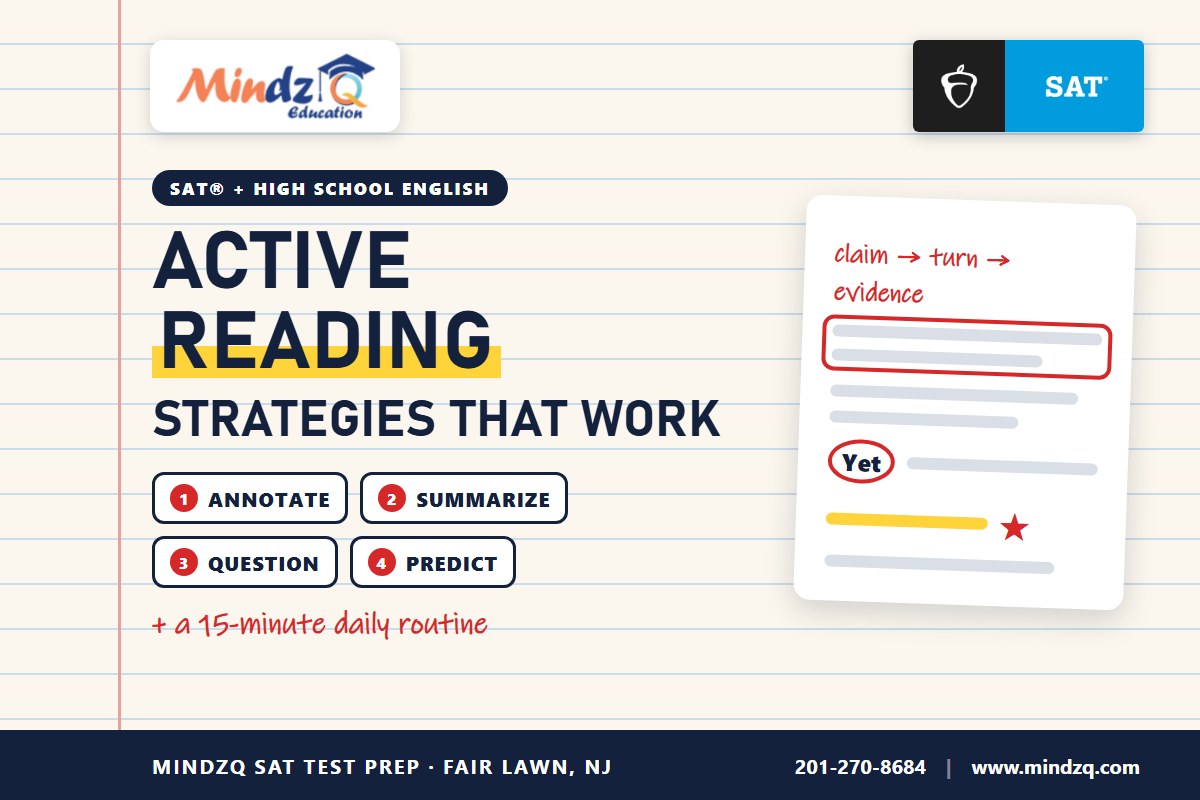
Annotating fails when it turns into highlighting everything. Try three marks only.
- Box the claim. Draw a box around the sentence that states the main point of a paragraph.
- Circle the turn. Circle words that change direction, such as "but," "however," "yet," or "although."
- Star the evidence. Put a star by one detail that supports the claim.
Here is a short passage we wrote for practice. It is not from the SAT.
The town library had always been quiet, which is why the new fountain in its courtyard caused such trouble. Some readers loved the sound of the water. Others said it made concentration impossible. Yet the librarian, who had resisted the fountain at first, noticed that the courtyard tables were now full every afternoon.
A student using the three marks would box the sentence about the fountain causing trouble, circle "Yet," and star the courtyard tables being full. In ten seconds the passage reduces to a claim (the fountain divided readers), a turn (the librarian changed her view), and evidence (the full tables).

In our diagnostic sessions at MindzQ Education, students often underline half a paragraph instead of choosing the one sentence that matters. Limiting the marks forces the choice.
How do you summarize and question a text?
Summarize in one line. After each paragraph, write six to ten words in the margin that say what the paragraph does. For the library passage: "Fountain divides readers, then draws a crowd." A paragraph that cannot be summarized in one line was not understood yet, so it gets another look.
Question as you go. Write one question per page in the margin. Good questions ask why the author chose a detail ("Why does the librarian resist at first?"), what a word means in context, or what the author is leaving out. Questions turn reading into a conversation.
Check the summary against the original. Before moving on, ask whether the summary would still make sense to someone who had not read the page. If it would not, add the missing piece.
How does predicting help?
Predicting means stopping at a turning point and guessing what happens or what the author will say next. After "Some readers loved the sound of the water. Others said it made concentration impossible," a reader might predict a compromise, a ruling, or a surprise.
The guess does not have to be right. A wrong prediction shows the reader exactly what the author did differently, and that gap is where the meaning lives. Predicting also keeps a student reading with the question in mind, which makes the rest of the passage easier to hold.
How does active reading help on the SAT?
The digital SAT's Reading and Writing passages "range from 25 to 150 words," and each passage is "followed by a single multiple-choice question"[3]. The section's questions come from four domains: Information and Ideas, Craft and Structure, Expression of Ideas, and Standard English Conventions[3]. Passages draw on literature, history and social studies, the humanities, and science[3].
Short passages change how annotation works. A student does not need five marks on a 40-word passage. The habit to bring is reading with the question in mind: after the first read, what is the passage mainly doing, and which detail would support or contradict a choice?
Pacing matters too. Our post on SAT time management shows how many seconds each question allows, and our overview of the digital SAT explains the format. Active reading should speed answers up, not slow them down, so practice the marks until they take seconds.
Want to see which reading habit is holding a student back? A free consultation and diagnostic assessment shows where to start. Call or text +1-201-270-8684, or book a free consultation.
How does it help in high school English?
Class texts are long, and tests ask about themes, tone, and an author's choices. Active reading scales up by chunking. At the end of each chapter or section, a student writes one sentence on what happened, one on what it suggests about a character or theme, and one question to bring to class.
Those three lines per section also become the raw material for essays. A student who has them can find evidence quickly instead of paging through the book. They also make class discussion easier, because the student arrives with a question already written.
Vocabulary supports this work. Our post on why middle school is the window for vocabulary covers how word knowledge builds over months, and our English reading and writing program works on these skills with students.
What is a 15-minute daily routine?
This is our suggested routine. Adjust the pieces to the student.
| Minutes | Task |
|---|---|
| 0 to 8 | Read one article, chapter section, or SAT-length passage with the three marks |
| 8 to 11 | Write a one-line summary for each paragraph |
| 11 to 13 | Write two questions and one prediction |
| 13 to 15 | Check the summaries against the text and fix one |
Do it five days a week for four weeks. After a month, compare how quickly the student can state a passage's main point out loud. For students in the area, our reading support in Fair Lawn can add feedback on the marks and summaries.
What mistakes slow students down?
- Highlighting everything. If every line is marked, nothing stands out.
- Writing summaries that repeat the text. A summary should be shorter and in the student's own words.
- Skipping the second read. The first read is for the story, and the second is for the author's choices.
- Never checking predictions. The learning is in the gap between guess and result.
- Practicing only on easy texts. Include material one level harder than comfortable.
Frequently asked questions
Do active reading strategies really improve comprehension?
The IES practice guide recommends explicit instruction in them[1]. The reciprocal teaching evidence is mixed[2], so expect gains from consistent practice, not from a single technique.
How many marks should a student make on an SAT passage?
Passages are short, 25 to 150 words[3], so one or two marks and a quick sense of the main point are usually enough.
Should students annotate on the screen?
Bluebook allows highlighting and notes on non-math questions, and the College Board's student guide describes the tool[4]. Practice with whatever tool will be used on test day.
How soon will a student see results?
It varies. A month of daily practice is a reasonable test of whether the habits are working.
Get help building reading habits
MindzQ Education offers English reading and writing support and SAT preparation with diagnostic sessions. Reach out any of these ways:
- Call or text us at +1-201-270-8684
- Chat with a MindzQ Education advisor on WhatsApp
- Or book a free consultation through our website and we'll follow up within a day
Read with a purpose on every page, and the marks start to do the thinking.
Sources
- Improving Adolescent Literacy: Effective Classroom and Intervention Practices, Institute of Education Sciences (2008 practice guide, REL Southeast summary)
- Reciprocal Teaching, WWC Intervention Report, Institute of Education Sciences (2010)
- The Reading and Writing Section, College Board
- 2026-27 SAT Weekend Student Guide, College Board
SAT is a registered trademark of College Board, which is not affiliated with MindzQ Education and does not endorse this article.