- 11
- By MindzQ Education Team
SAT Time Management: A Pacing Plan for Every Module
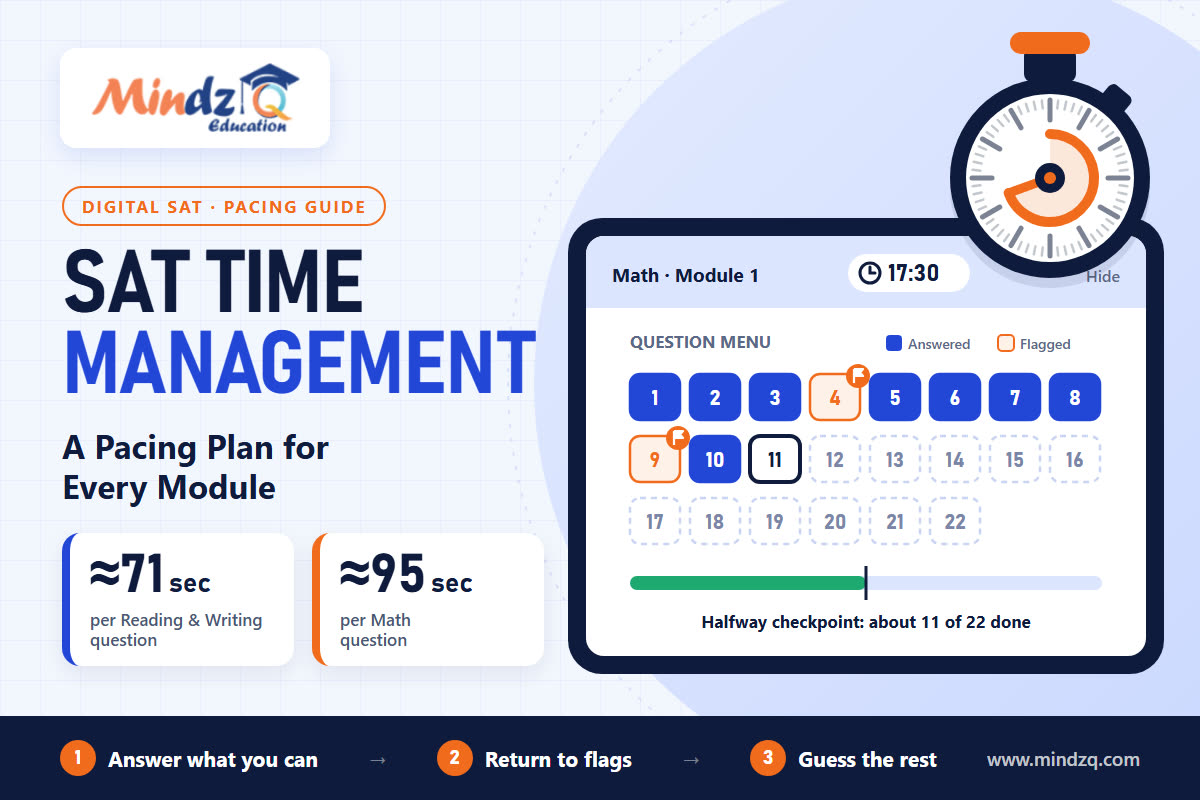
How long should your child spend on one SAT Math question? About 95 seconds, on average. Give one stubborn problem three minutes and the questions at the end of the module pay for it.
Reading and Writing is tighter, at about 71 seconds. Below you will find the numbers, a three-pass method, and a way to practice pacing before test day.
- How much time do you get per question on the digital SAT?
- Why does pacing matter more on an adaptive test?
- What are the rules of the clock inside Bluebook?
- What is the best three-pass method for each module?
- How should you pace Reading and Writing?
- How should you pace Math?
- How do you practice pacing before test day?
- What about nerves and attention over a 2-hour test?
- What mistakes cost students the most time?
- Frequently asked questions
- Key takeaways
- Sources
How much time do you get per question on the digital SAT?
The College Board's published structure gives the totals[1]. The per-question figures below are our arithmetic from those totals, and they assume each module in a section has the same number of questions, which the College Board's Bluebook practice page says is the case[3].
| Section | Time | Questions | Per module | Seconds per question (approx.) |
|---|---|---|---|---|
| Reading and Writing | 64 minutes, two 32-minute modules | 54 | 27 | 71 |
| Math | 70 minutes, two 35-minute modules | 44 | 22 | 95 |
The whole test runs 134 minutes (2 hours and 14 minutes) across 98 questions, with a 10-minute break between sections[1]. Each module also contains two unscored pretest questions, mixed in with the scored ones[5]. You cannot count on spotting them, so treat every question as if it counts.
Those are averages. A quick grammar question should take 30 seconds. A multi-step word problem may deserve three minutes. Time management means spending the difference on purpose instead of by accident.
Why does pacing matter more on an adaptive test?
The digital SAT is adaptive by module. The College Board says your first module has "a broad mix of easy, medium, and hard questions," and your performance on it decides whether the second module is harder or easier[1]. The student guide puts it this way: "The questions that you are given in the second module depend on how you performed on the first module"[2].
That makes the first module of each section worth protecting. If you burn eight minutes on two hard questions early in Module 1, you rush the rest and miss easier points, and that can affect which second module you get. The published description supports a simple idea: a clean, steady first module sets up everything after it.
What are the rules of the clock inside Bluebook?
Knowing the tools saves seconds. According to the 2026–27 student guide[2]:
- A clock counts down the time left in each module. You can hide it, and you get an alert when 5 minutes remain.
- You can "flag and return to any question within a given test module."
- You can "navigate to any question in the module" from the question menu.
- A built-in Desmos calculator is available for the entire Math section, and you can toggle between scientific and graphing versions.
- In Math, a list of common formulas is available.
- On non-math questions, you can highlight a passage and leave yourself a note.
The guide does not say whether you can return to a module after you finish it. Plan as if you cannot. Finish and check your work inside each module while the clock runs.
What is the best three-pass method for each module?
This is our recommended method, not an official College Board procedure. It gives you a plan for the moment a question stalls.
Pass 1: answer what you can in under your budget. Move fast through questions you know. If you cannot see a path in about 30 seconds, pick your best guess, flag the question, and move on.
Pass 2: return to flagged questions. After you reach the end, use the question menu to go back to the flags. You now have a clearer sense of how much time is left. Work the flagged questions in the order of easiest first.
Pass 3: guess everything left. The student guide says "For most students, it's better to guess than leave a question blank"[2]. When the 5-minute alert appears, you should have an answer in every box. Use the remaining time to improve guesses, not to start fresh.
The method has one rule that students resist: when a question stalls, you leave it. Leaving it does not mean giving up on the question. It means giving the question a second chance with a calmer head, after you have banked the points that are within reach.
How should you pace Reading and Writing?
You have about 71 seconds per question. The College Board says the passages in this section "range from 25 to 150 words," and each passage or pair of passages is followed by a single multiple-choice question[4]. Because each passage is short, you can afford to read it carefully once.
The College Board also notes that questions testing similar skills are grouped together and arranged from easiest to hardest[4]. In practice, that tells you the clock should not feel the same all the way through a group. Early questions in a group should go quickly. Slow down as they get harder.
A rhythm to try:
- Grammar and conventions questions: 30 to 45 seconds.
- Vocabulary in context: 45 to 60 seconds.
- Questions about evidence and inference: 75 to 100 seconds.
Those ranges are our suggestions. Time yourself on real practice to find your own. If grammar questions run long for your child, the fix is rules practice, not more minutes.
How should you pace Math?
You have about 95 seconds per question, and the calculator is built in. The built-in Desmos graphing calculator can turn a slow algebra problem into a quick intersection on a graph[2]. It is easy to forget that under pressure and grind through algebra by hand.
Three habits help:
- Decide in 10 seconds how you will solve it. If you cannot decide, flag it.
- Use Desmos on purpose. Practice graphing equations and checking solutions before test day so the tool feels natural.
- Watch the clock at the halfway mark. In a 35-minute module, you should be about 11 questions in at the 17-minute point. That is a checkpoint, not a rule.
Student-produced response questions leave no answer choices to eliminate. Budget a little more time for them, and always enter an answer.
In our diagnostic sessions at MindzQ Education, students often spend the most time on the first hard-looking question of a module. It feels important because it comes first. It is worth exactly one question.
Want to see where the time goes? A diagnostic shows which questions slow your child down. Call or text +1-201-270-8684, or book a free consultation.
How do you practice pacing before test day?
Official Bluebook practice tests use "the same multistage adaptive model" as the real test, which makes them the right tool for pacing practice[3]. The College Board recommends taking at least one full practice test in a single sitting, in a quiet place at a desk or table, to simulate test day[3].
After each test, use the score details to review every question, the answer you gave, and the correct answer[3]. Then build an error log with one extra column the College Board does not require: time spent. For every miss, tag it as one of three types:
| Type | What happened | Fix |
|---|---|---|
| Didn't know | The content was missing | Study the skill |
| Knew it, ran out of time | Pacing problem | Practice with a timer |
| Careless | Misread or slipped | Slow down, check units and signs |
If most of your child's mistakes are the second or third type, more content review will not help. The College Board suggests using practice tests to find your own approach, such as when to read passages versus questions and when to flag a question[3]. Our 3-month SAT study plan shows where full practice tests fit in a longer schedule.
What about nerves and attention over a 2-hour test?
A test that lasts 134 minutes tests stamina as well as skill. The guide says Bluebook will tell you when to take your break, and the break sits between sections[1][2].
Use the break. Stand up, drink water, eat something small, and do not review questions from the first section. If nerves are part of the picture, our post on SAT test anxiety strategies covers what helps before and during the test.
What mistakes cost students the most time?
- Reading the passage three times. Read it carefully once, then answer.
- Solving every math problem the textbook way. Look for the graph, the plug-in, or the shortcut first.
- Leaving a question blank "to come back." Enter a guess before you flag it.
- Changing answers at the end without a reason. Change an answer only if you can name the mistake.
- Hiding from the timer. Some students find the clock stressful and hide it. That is allowed[2]. If you hide it, set your own checkpoints and check the time at each one.
Frequently asked questions
Is there a penalty for wrong answers on the digital SAT?
The student guide does not describe a penalty and advises that "for most students, it's better to guess than leave a question blank"[2].
Can I go back to a question?
Yes, within the module you are in[2]. The guide does not say you can return to a module you have finished.
How long is the digital SAT?
The College Board lists 134 minutes of testing, or 2 hours and 14 minutes, across 98 questions[1].
Should my child hide the timer?
The student guide says you can hide it[2]. If it raises anxiety, hiding it and using your own checkpoints can work. Our comparison of the SAT and the ACT may also help if your family is still deciding which test fits.
What if my child freezes on a hard question?
Flag it, guess, and move on. The method above gives a plan to return with a calmer head.
- The numbers. About 71 seconds per Reading and Writing question and 95 per Math question, from the College Board's totals[1].
- Module 1 steers Module 2. The second module depends on how you do on the first[1][2].
- Three passes (our method). Answer what you can, flag what stalls, then guess everything left before the 5-minute alert.
- Guess, don't blank. The student guide says it is better for most students to guess than leave a question blank[2].
- Practice the clock. Official Bluebook practice tests use the same adaptive model[3].
Get a pacing diagnostic
A full-length practice test shows where time goes. MindzQ Education offers SAT preparation with diagnostic sessions through our MindzQ SAT Test Prep program, and we run local sessions in Fair Lawn. Our overview of the digital SAT is a good place to begin if the format is new. Reach out any of these ways:
- Call or text us at +1-201-270-8684
- Chat with a MindzQ Education advisor on WhatsApp
- Or book a free consultation through our website and we'll follow up within a day
The clock is part of the test, so practice it the way you practice the content.
Sources
- College Board, How the SAT Is Structured
- College Board, 2026-27 SAT Weekend Student Guide (PDF)
- College Board, How to Use Bluebook Practice Tests
- College Board, The Reading and Writing Section
- College Board, Digital SAT Test Specifications Overview (PDF)