- 25
- By MindzQ Education Team
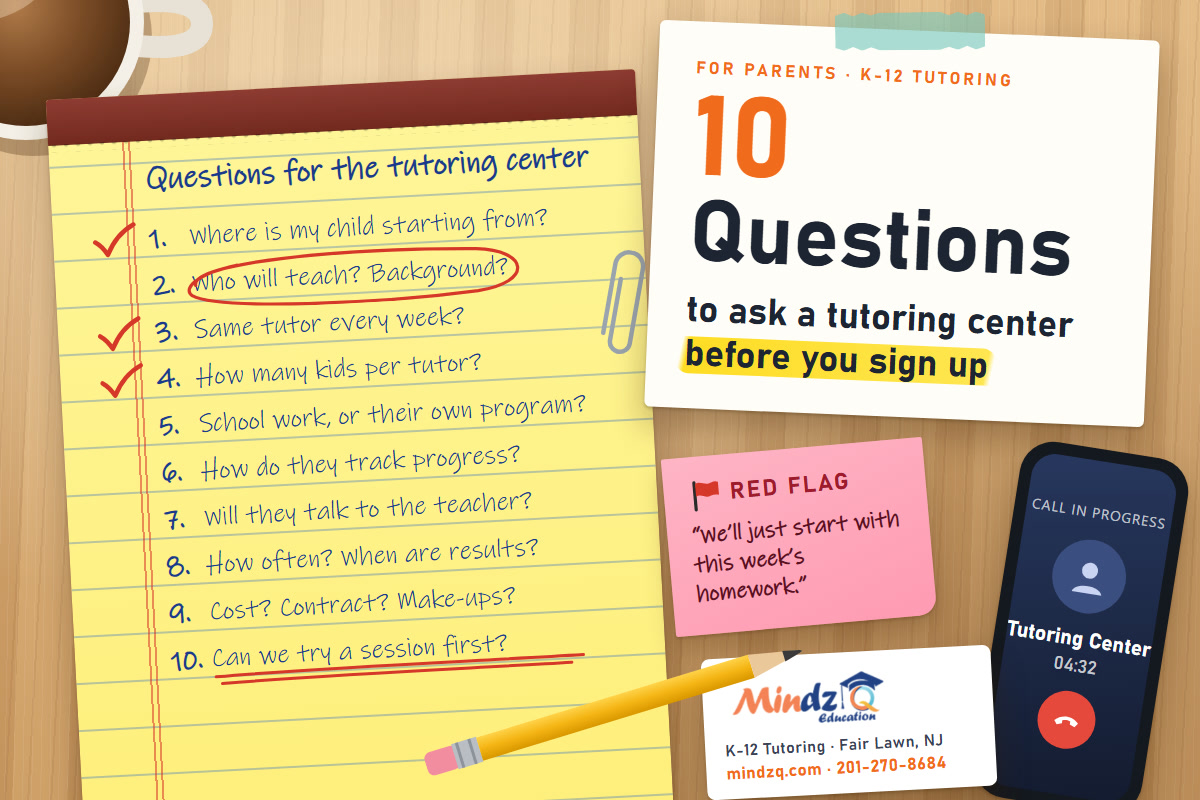
10 Questions to Ask a Tutoring Center Before You Sign Up
You've decided your child could use some help. Maybe a report card came home with a grade that surprised you, or homework has turned into a nightly fight. Now you're looking at tutoring centers, and every website says the same things: personalized, experienced, proven.
The website won't tell you much. The first phone call or visit will, if you ask the right questions. Below are the ten we'd ask, what a good answer sounds like, and the red flags that should make you keep looking. Yes, these apply to us too.
- Start with the assessment. A good center tests your child before it builds a plan. If it can't explain where your child is starting from, it can't show you progress later.
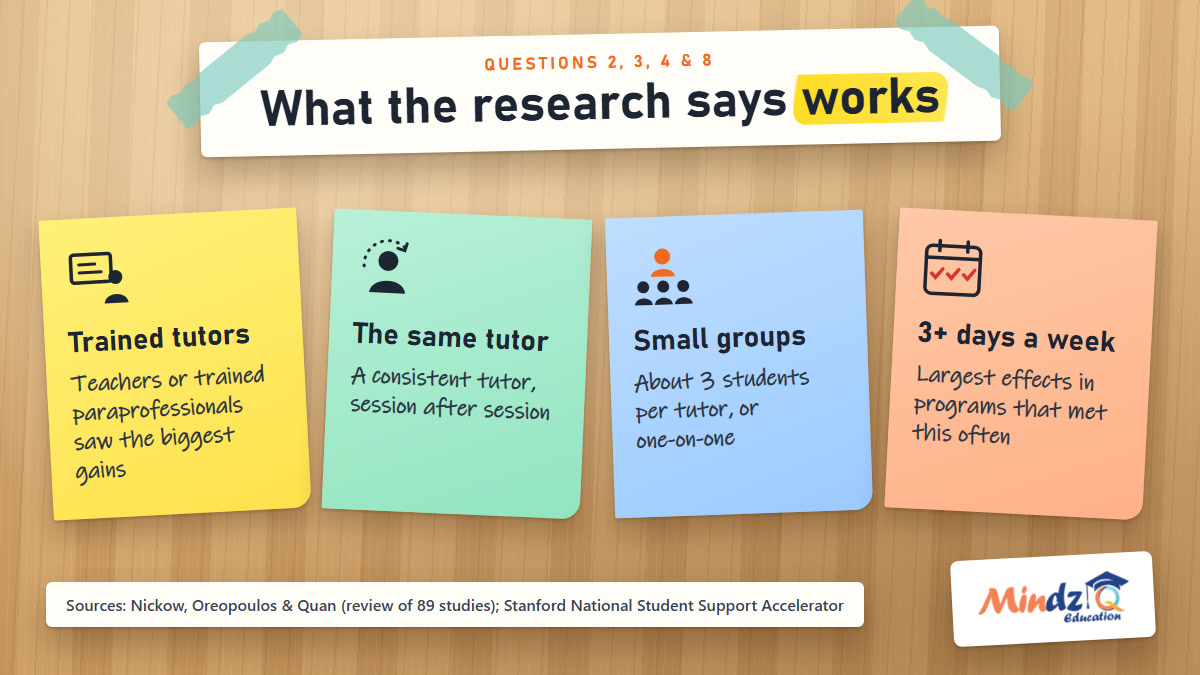
- Ask who actually teaches. Research on tutoring finds the biggest gains when trained teachers or paraprofessionals do the tutoring, with the same tutor each time.
- Get the progress plan in writing. Know how progress will be measured, how often you'll hear about it, and what happens if it isn't working.
- Try before you commit. A trial session shows you more than any brochure, and your child's opinion of it counts.
Before you call: know what you want help with
You'll get better answers if you can say in one or two sentences what's going wrong. "She's fine in class but freezes on tests" is a different problem from "he never really got fractions, and now algebra makes no sense." Bring what you have: the last report card, a graded test or two, and any notes from the teacher.
If you're still not sure tutoring is needed at all, start with our guide to the signs your child may need a tutor. For math, our grade-by-grade math checklist can help you name the gap before you call.
The 10 questions to ask a tutoring center
1. How will you find out where my child is starting from?
This is the most important question, so ask it first. A tutor who skips the assessment is guessing. They may spend weeks on things your child already knows while the real gap stays open.
A good answer: A diagnostic test or skills check before lessons start, followed by a conversation with you about what it found. You should come away knowing your child's two or three weakest skills, not just a score.
Red flag: "We'll just start with this week's homework." Homework help is useful, but on its own it treats the symptom. If the problem started two grades ago, today's worksheet won't reach it. Our post on how to identify math learning gaps explains why the starting point matters so much.
2. Who will teach my child, and what's their background in this subject?
Some centers hire experienced teachers. Others rely mainly on college or high school students. Both can work for some needs, but you should know which one you're paying for.
The research leans one way here. A large review of 89 randomized studies found that tutoring helps students learn, and the biggest gains came from programs that used teachers or trained paraprofessionals as tutors (Nickow, Oreopoulos and Quan[1]).
A good answer: Specific details. Who the tutor is, how long they've taught this subject at this grade level, and whether they've worked with students who struggle in the same way your child does. Understood.org[2] also suggests asking for references you can call.
Red flag: "All our tutors are great." That's a sales line, not an answer.
3. Will my child work with the same tutor every week?
Kids open up to someone they know. A tutor who has seen your child for six weeks knows which mistakes are careless and which are real gaps. A new face every session has to start over each time.
Stanford's National Student Support Accelerator, which studies what makes tutoring work, lists a consistent tutor as one of the core features of high-impact tutoring (NSSA[3]).
A good answer: Yes, with a clear plan for when that tutor is out. Who covers, and how will the substitute know what your child is working on?
4. Is it one-on-one or a group, and how many students per tutor?
Both can work. One-on-one gives your child the tutor's full attention. A small group can cost less and suits kids who like working next to peers. The key word is small. NSSA's guidance for high-impact tutoring keeps groups to about three students per tutor (NSSA[3]).
A good answer: A real number, and a reason the center would suggest one format over the other for your child.
Red flag: A "small group" that turns out to be eight or ten students with one adult walking between tables. That's closer to a study hall than tutoring.
5. Will you follow my child's school curriculum or your own program?
Ideally, both. Your child needs help with what's happening in class right now, like this week's quiz or next month's unit test. They may also need to go back and fix older skills the school has moved past.
A good answer: The tutor works from your child's actual school materials and test dates, and also has a plan for the older gaps the assessment found.
Red flag: A fixed workbook program that every student follows in the same order, no matter what's happening at school.
6. How will you track progress, and how often will I hear from you?
"Is it working?" is the question you'll be asking in a month. Agree now on how you'll answer it. Understood.org puts this on its own list: How will you measure and share progress? (Understood.org[2])
A good answer: A check-in schedule (a short note after sessions, a conversation every few weeks, or both) and a measure that ties back to the first assessment, such as a re-test on the same skills.
Red flag: Progress means "your child seems happier." That matters, but it isn't a measure.
7. Will you work with my child's teacher?
The teacher sees your child every day. The tutor sees them for an hour or two a week. When the two share information, like upcoming test dates, the topics coming next, or what the teacher is noticing in class, tutoring time goes where it's needed most.
A good answer: Yes, with your permission. That might mean reviewing the class syllabus, looking at graded tests, or reading notes you pass along from parent-teacher conferences.
8. How many sessions a week do you recommend, and when should we see results?
Frequency matters. In the research review above, effects were largest for programs that met at least three days a week (Nickow, Oreopoulos and Quan[1]). Keep in mind that most of those programs ran during the school day. For after-school tutoring, most families do one or two sessions a week, and that's often enough when the gap is small. A bigger gap or a close deadline, like midterms, may need more.
A good answer: A recommendation based on your child's assessment, not a standard package. On results, an honest center will say you should see early signs within a few weeks, like fewer repeated mistakes, homework done with less help, and more confidence. Test grades often take longer to move.
Red flag: A promise of a specific grade or score by a specific date, with no plan behind it. No one can promise that honestly before they've worked with your child.
9. What does it cost, and what exactly am I signing up for?
Ask for the full picture, not just the hourly rate.
- Is it priced per session, per month, or as a package?
- Is there a minimum commitment or a contract?
- What happens if your child is sick and misses a session? Can it be made up?
- What's the cancellation policy if tutoring isn't working out?
- Is the first assessment free or paid?
Also ask the question Understood.org recommends: What happens if my child doesn't make progress? (Understood.org[2]) A good center has a plan for that, like changing the approach, the format, or the tutor.
Red flag: Pressure to prepay for a large package before your child has had a single session.
10. Can my child try a session first?
You can learn a lot from a phone call. Your child will learn more from one hour with the tutor. A trial session lets you see how the tutor explains things and whether your child feels comfortable asking questions.
Afterward, ask your child two simple questions: "Did the tutor explain things in a way that made sense?" and "Would you go back?" Kids who feel heard in tutoring are much more likely to keep showing up. That's one reason tutoring can build confidence, not just grades.
Red flag: No trial, no meeting the tutor, and no assessment before you pay.
Quick checklist: good answers and red flags
Print this or keep it on your phone for the call.
| Question | A good answer sounds like | Red flag |
|---|---|---|
| 1. Where is my child starting from? | Diagnostic test first, then a talk about the results | "We'll start with homework" |
| 2. Who will teach? | Named tutor, subject experience, references | "All our tutors are great" |
| 3. Same tutor each week? | Yes, with a plan for absences | Whoever is free that day |
| 4. How many students per tutor? | One-on-one, or a real small group | 8 to 10 students per adult |
| 5. School curriculum or your own? | Both: current classwork plus older gaps | Same workbook for everyone |
| 6. How will you track progress? | Regular updates and a re-test | "Your child seems happier" |
| 7. Will you work with the teacher? | Yes, with your permission | No interest in school materials |
| 8. How often, and when will we see results? | Based on the assessment; early signs in weeks | A guaranteed grade by a date |
| 9. What does it cost? | Clear pricing, make-up and cancellation policy | Big prepaid package up front |
| 10. Can we try a session? | Yes, trial or first session before you commit | Pay before meeting anyone |
Red flags that should make you walk away
One weak answer isn't a dealbreaker. A pattern is. Keep looking if a center:
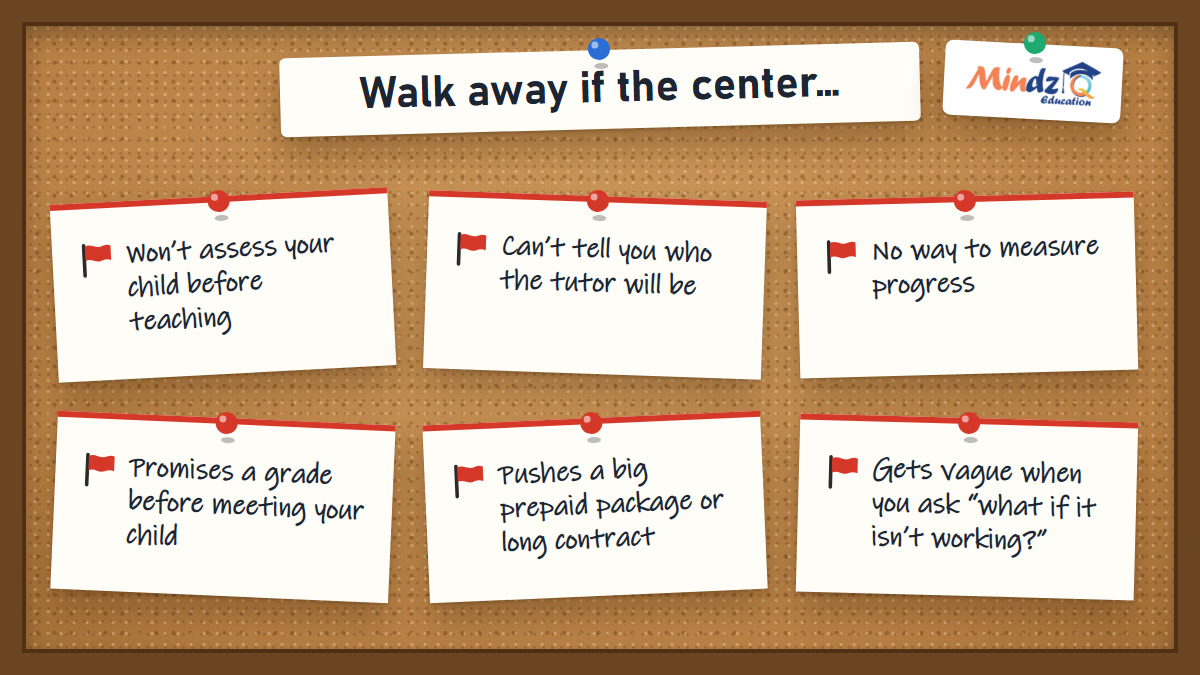
- won't assess your child before teaching
- can't tell you who the tutor will be
- has no way to measure progress beyond "they're doing great"
- promises a specific grade or score before meeting your child
- pushes a large prepaid package or a long contract on the first call
- gets vague when you ask what happens if tutoring isn't working
Questions parents ask about choosing a tutoring center
What should I look for in a tutoring center?
Look for four things: an assessment before teaching, qualified tutors who stay with your child, small groups or one-on-one sessions, and a clear way to measure progress. A center that does all four can show you whether tutoring is working.
Is a tutoring center better than a private tutor?
Not always. A private tutor can be a great fit if you find the right person. A center usually adds structure: assessments, a set curriculum, backup when a tutor is out, and someone to call if things aren't working. Ask either one the same ten questions.
How many tutoring sessions a week does my child need?
For a small gap, one or two sessions a week is often enough. For a bigger gap or a close deadline, more sessions help. Research on tutoring found the largest gains in programs that met at least three days a week.
How long does it take to see results from tutoring?
You should see early signs within a few weeks, like fewer repeated mistakes, more independent homework, and more confidence. Test grades often take longer to move, especially when the gap goes back more than one grade.
Should my child come to the first meeting?
Yes, if they're old enough to talk about school. Your child knows best where they get stuck, and they're the one who has to work with the tutor. Their opinion after a trial session is one of the best signs of fit.
How MindzQ answers these questions
We wrote this list knowing parents will ask it of us too. Here's where we stand on the questions above.
- Starting point (question 1). We begin with a free, full-length diagnostic test to find your child's strengths and gaps, then build a customized plan from it.
- Format (question 4). Classes are one-on-one or in small groups, in person at our Fair Lawn center or online.
- School and older gaps (question 5). Our K-12 math tutoring runs two tracks. The remedial track follows your child's school curriculum, with homework support and quiz and test preparation, while closing earlier gaps. The accelerated track is for students ready to go beyond grade level, including Math Kangaroo and AMC. We also offer reading and writing tutoring.
- Trying first (question 10). We offer free trial classes, so your child can meet a tutor before you commit.
Our tutoring sessions run weekdays from 4:30 to 8:00 PM and Saturdays from 9:00 AM to 12:30 PM at 19-03 Maple Ave, Unit 3, Fair Lawn, NJ. Families come from across Bergen and Passaic counties. For everything else on this list, including tutors, progress updates and pricing, ask us directly or call +1-201-270-8684. We'd rather you ask than guess. See our tutoring center and math tutoring in Fair Lawn pages for more.
Sources
- Nickow, A., Oreopoulos, P., and Quan, V., The Promise of Tutoring for PreK-12 Learning: A Systematic Review and Meta-Analysis of the Experimental Evidence (National Student Support Accelerator, Stanford University; earlier version: NBER Working Paper 27476)
- Understood.org, Questions to ask when hiring a tutor
- National Student Support Accelerator, Stanford University, What is high-impact tutoring?