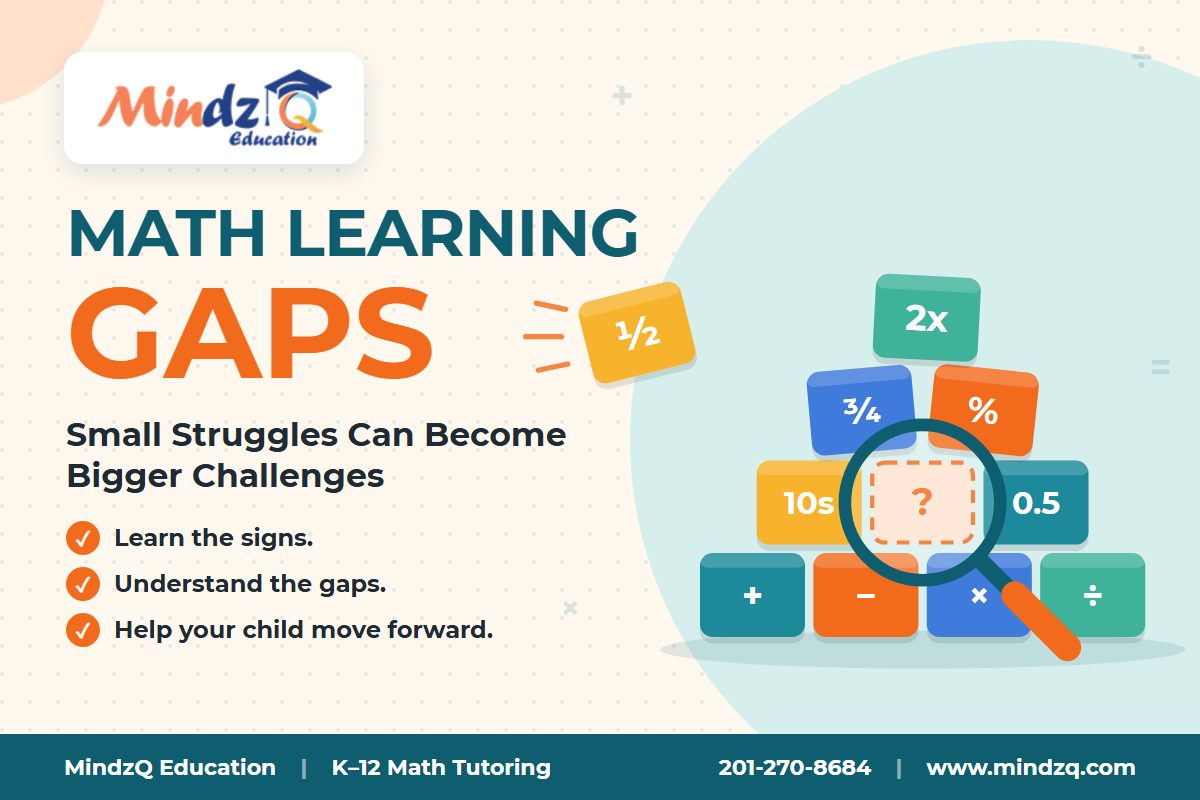
Math Learning Gaps: How to Identify Them Before They Grow
Have you ever sat with your child during homework and noticed that a math problem they solved last week suddenly seems confusing? Maybe they can answer multiplication questions but struggle when those same numbers appear in a word problem. Or perhaps they understand a lesson in class but cannot explain how they got the answer when you ask them at home.
These situations are familiar to many parents.
Sometimes, a child is not struggling with the entire subject. They may have missed one important concept or never fully understood a topic that later lessons depend on. These small misunderstandings are known as math learning gaps.
The tricky part is that they are not always easy to notice. A student may continue completing assignments and moving from one grade to the next while quietly struggling with certain skills.
Recognizing these difficulties early can make a real difference. Instead of waiting until math becomes a major source of frustration, parents can find out what is confusing their child and help them work through it.
Let's look at what math learning gaps actually mean, what signs to watch for, and how you can support your child at home.
What Are Math Learning Gaps?
A math learning gap is an area of mathematics that a student has not fully understood or mastered.
Think about a child learning fractions. Before working with fractions, students need a reasonable understanding of division and how numbers relate to one another. If those earlier concepts are unclear, comparing fractions or finding a common denominator may become difficult.
The same thing happens with other math topics.
A student who struggles with multiplication may find long division challenging. A child who has difficulty understanding place value may make repeated mistakes when working with decimals.
This does not mean the child cannot learn these topics. It simply means there may be something important that needs to be reviewed before moving ahead.
Math learning gaps can appear in different areas, including:
- Addition, subtraction, multiplication, and division
- Fractions, decimals, and percentages
- Number patterns and place value
- Measurement and geometry
- Mathematical reasoning
- Word problems and multi-step calculations
The first step is finding out exactly where the difficulty begins.
6 Signs Your Child May Be Struggling With Math
Every child has an occasional difficult homework day. One incorrect answer or a low test score does not necessarily indicate a learning gap.
However, if you notice the same problems happening repeatedly, it may be worth taking a closer look.
1. Simple Homework Questions Take Too Much Time
Your child sits down to complete a math worksheet, but a few questions take much longer than expected. You explain the first one, help with the second, and before long, the entire assignment becomes a struggle.
This can happen when a student does not fully understand the concept behind the questions.
For example, a child may know the multiplication table but struggle when asked to multiply larger numbers. They might remember the answer to familiar questions but become confused when the format changes.
Pay attention to which questions cause the most difficulty. That information can help you understand whether your child needs additional practice or a clearer explanation.
2. Your Child Understands a Lesson but Cannot Remember It Later
Have you ever noticed your child solving a problem correctly one day and struggling with a similar question a few days later?
This can happen when students memorize a method without fully understanding it.
For example, a student might follow the steps for adding fractions during a lesson but become confused when asked to solve a slightly different problem independently.
Rather than asking your child to repeat the same worksheet, try using a different example. Ask them to explain each step in their own words.
If they cannot explain why they are using a particular method, the concept may need another review.
3. Word Problems Are More Difficult Than Regular Calculations
Some students are comfortable with numbers but find written math questions confusing.
For instance, your child may solve 8 × 5 correctly but struggle with a question asking how many items are needed for eight groups of five.
The calculation is the same, but the student must first understand the situation described in the question.
Word problems involve reading, understanding information, identifying what is being asked, and choosing the right operation.
If this sounds familiar, spend some time discussing the question before asking your child to calculate the answer.
4. Your Child Avoids Math Homework
Not every child enjoys homework, but a repeated reluctance to work on mathematics may be worth noticing.
Some children avoid math because they do not know where to begin. Others become frustrated after making the same mistakes several times.
Instead of immediately telling your child to concentrate harder, ask which part is difficult.
Is it understanding the question? Remembering the steps? Or checking whether the answer is correct?
Sometimes, identifying the actual problem is more helpful than simply asking children to spend more time studying.
5. The Same Mistakes Keep Appearing
A student might repeatedly forget to carry numbers during addition, confuse multiplication with addition, or make mistakes when working with fractions.
Occasional errors are expected. But when the same type of mistake appears in different assignments, it may indicate that the underlying concept needs attention.
Look at how your child reaches an answer, not just whether the answer is right or wrong.
For example, two students may get the same question wrong for completely different reasons. One may misunderstand the instructions, while another may not understand the mathematical operation.
Knowing the difference helps parents decide what needs to be reviewed.
6. Your Child Needs Help With Almost Every Question
It is normal for students to ask questions when learning something new.
However, if your child cannot complete familiar problems without someone sitting beside them, they may need more opportunities to practice independently.
Try giving them a few questions they have already studied. Allow them to work through the problems without immediately stepping in.
Notice where they get stuck. This can help you understand whether they remember the concept and know how to apply it.
Why Do Children Develop Math Learning Gaps?
There is not always one clear reason behind a child's math difficulties. In many cases, several small factors contribute to the problem.
Missed lessons: School absences, classroom changes, or moving to a new school can sometimes leave students unfamiliar with important topics.
Unclear understanding of earlier concepts: Mathematics builds from one topic to another. A child who has not understood multiplication may have difficulty with division and more advanced calculations.
Not enough opportunities to practice: Some students understand a concept during class but need additional examples before they can solve questions independently.
Different learning needs: Children do not all understand a new topic in the same way. One student may learn through visual examples, while another may need to work through several practice questions.
Difficulty applying what they learn: A child may remember mathematical rules but struggle to use them in unfamiliar situations, especially in word problems.
Understanding why a student is struggling is just as important as recognizing the problem itself.
How Can Parents Identify Weak Math Skills at Home?
You do not need to prepare a formal examination to understand where your child needs help. A few simple observations during homework can tell you quite a lot.
Here are some practical things you can try.
Go back to earlier topics.
Choose a few questions from previous lessons. For example, if your child is currently studying fractions, review multiplication and division as well.
See whether they can solve the questions without looking at their notes. For a grade-by-grade list of the skills worth checking, see our K–8 math checklist for parents.
Ask your child to explain the answer.
Instead of asking only, "What is the answer?", try asking, "How did you solve it?"
A student who understands the concept should be able to explain at least the main steps in their own words.
Notice repeated mistakes.
Keep track of the types of questions that cause difficulty. If your child regularly struggles with fractions or word problems, those areas may need additional attention.
Talk to their teacher.
Your child's teacher can explain how they perform during classroom activities, quizzes, and assignments. This information can help you understand whether the difficulty is limited to homework or appears at school too.
A math skills assessment can also help identify specific areas where a student needs additional practice.
How to Help a Child Who Is Struggling With Math
Once you have a better idea of what is causing the difficulty, you can start working on it.
The goal is not to make your child complete as many questions as possible. It is to help them understand the concepts they are finding difficult.
Start With the Topic They Find Difficult
If your child is struggling with fractions, there is little benefit in rushing into more advanced topics without reviewing the basics.
Go back to the concepts they have already studied. Use simple examples and give them enough time to understand each step.
Use Everyday Examples
Children often understand math more easily when they can connect it to something familiar.
For example:
- Ask your child to calculate the total cost of a few grocery items.
- Use a pizza to explain fractions.
- Discuss discounts while shopping to introduce percentages.
- Ask them to measure ingredients while helping with a recipe.
- Use a calendar to practice dates and time calculations.
These activities make mathematics part of everyday life rather than something that only happens in a workbook.
Give Them Time to Solve Problems
When your child asks for help, avoid giving the answer immediately.
Ask what they already understand and which step is confusing. A small hint may be enough to help them continue.
This gives students an opportunity to think through the problem themselves.
Keep Practice Short and Consistent
Long study sessions can become tiring, especially when a child is already finding a subject difficult.
Instead, set aside a manageable amount of time for regular practice. Review one topic, work through a few questions, and discuss any mistakes.
The important thing is to make sure your child understands what they are practicing.
Consider Additional Math Support
Sometimes, parents can explain a topic several times and still find that their child needs a different approach.
This is where additional math tutoring may help.
A tutor can spend more time understanding which concepts are difficult, explain them using different examples, and provide practice based on the student's current level.
For children who need extra attention with school mathematics, math tutoring for struggling students can provide a more focused learning experience.
When Should You Consider Math Tutoring?
Parents do not need to wait until a child receives poor grades before considering additional academic support.
If your child regularly struggles with basic concepts, needs help with most homework questions, or finds it difficult to keep up with classroom lessons, it may be time to explore additional support.
Look for a tutoring approach that first identifies the student's weak areas instead of immediately moving into new lessons.
A good starting point is to understand:
- Which grade-level concepts does your child already understand?
- Which topics cause repeated confusion?
- Can your child solve familiar questions independently?
- Does your child need more practice or a different explanation?
These questions can help make tutoring more focused and useful.
How MindzQ Education Supports Students With Math
At MindzQ Education, we understand that not every student needs the same kind of academic support.
One child may need help with multiplication and division, while another may be ready for more challenging topics but struggle with word problems or mathematical reasoning.
Our K–12 tutoring programs focus on helping students work through the topics they find difficult with individual attention, clear explanations, and focused practice.
We aim to help students understand their school lessons rather than simply memorize answers for the next test.
For parents looking for additional math support in Fair Lawn, NJ, MindzQ Education offers academic tutoring designed around students' learning needs.
If your child is finding mathematics challenging, learning more about their specific difficulties is a good place to start.
Visit MindzQ Education to explore our tutoring programs.
MindzQ Education
Fair Lawn, NJ
Phone: +1 (201) 270-8684
Website: https://mindzq.com/
Frequently Asked Questions
1. How do I know if my child has math learning gaps?
Look for repeated difficulty with basic calculations, fractions, word problems, and previously learned topics. If your child regularly needs help with concepts they have already studied, it may be useful to review those areas more closely.
2. What are the common signs of a child struggling with math?
Common signs include taking a long time to complete homework, forgetting earlier lessons, making repeated calculation mistakes, avoiding math activities, and struggling to solve familiar questions independently.
3. Why is my child struggling with basic math?
There can be several reasons. Your child may have missed important lessons, may need more practice, or may not have fully understood earlier concepts. Speaking with their teacher can help you understand what is happening.
4. How can I improve my child's math skills at home?
Review difficult topics, practice regularly, use everyday activities to explain mathematical ideas, and encourage your child to explain how they solve problems. Focus on understanding rather than completing large numbers of questions.
5. Can math tutoring help a child who is falling behind?
Additional tutoring can give students more time to review difficult topics and practice at their own pace. A tutor can identify specific areas of difficulty and adjust instruction according to the student's needs.
6. When should parents consider a math skills assessment?
Consider an assessment when your child repeatedly struggles with particular topics or has difficulty applying previously learned concepts. It can help identify which skills need additional attention.
Final Thoughts
Sometimes, the reason a child struggles with a new math topic is not the topic itself. It may be something they learned several months ago but never fully understood.
That is why parents should pay attention to the small signs. A repeated mistake, a confusing homework question, or difficulty explaining an answer can tell you where your child may need help.
Take the time to understand what is causing the difficulty. Speak with their teacher, review earlier concepts, and consider additional support if needed.
The sooner children get help with the topics they find difficult, the easier it can be to approach the next lesson with a better understanding.