SAT Winter Break Study Plan: A 2-Week Schedule (With Days Off)
Here's an SAT calendar fact a lot of families miss: after the December 5 test, there is no SAT in January or February. The next one is March 6, 2027[1]. Winter break sits right in that gap, about ten weeks before test day.
That makes break a good time to start SAT prep, or restart it. It also makes it easy to waste. Ten days off sounds like a lot of study time, and that's usually the trouble. The plan gets too big, the first two days go well, and by New Year's Eve nobody has opened Bluebook in a week.
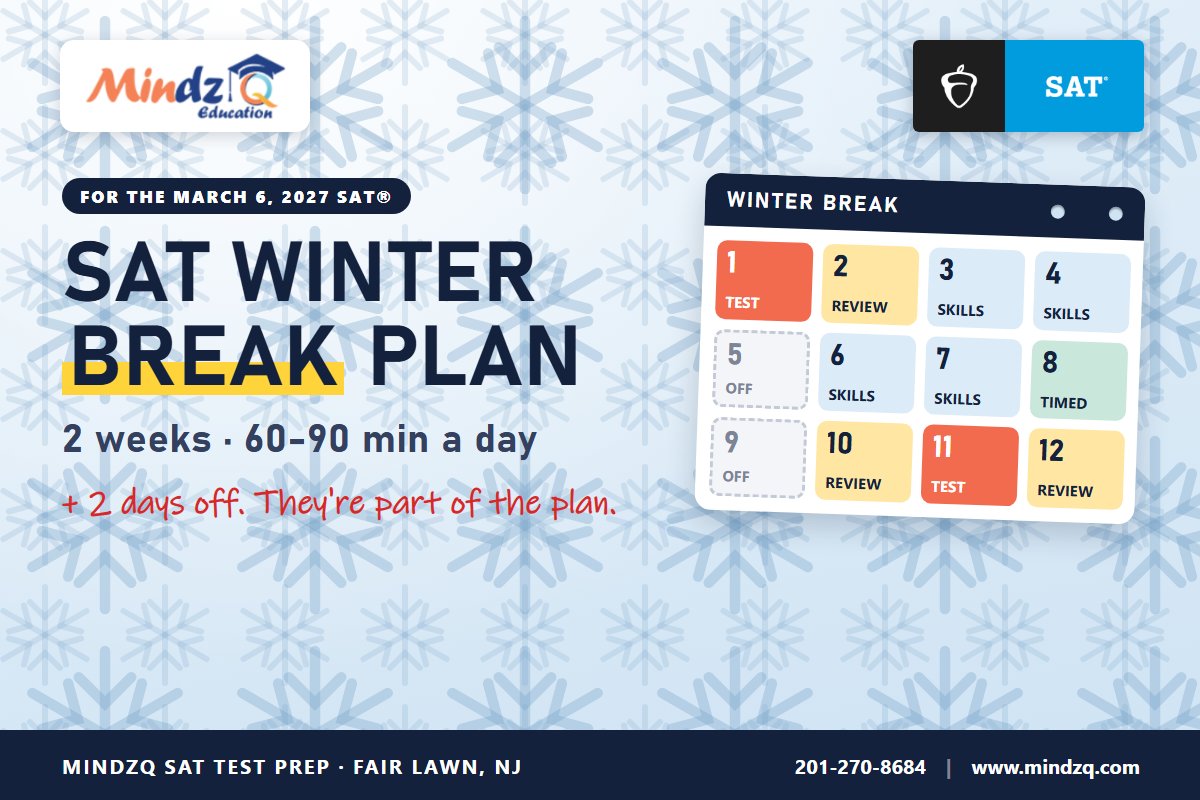
Below is the plan we'd hand a junior who is aiming for the March SAT. It asks for 60 to 90 minutes on most days, two full practice tests, one mistake log, and real days off for the holidays. It works for students who took the December test, too.
- A little every day beats a lot on one day. Plan on 60 to 90 minutes, plus two longer mornings for full practice tests.
- Test, review, fix, retest. One full Bluebook practice test at the start of break and one at the end, with skill work in between.
- Keep a mistake log. Put every wrong answer in one of three buckets so you know what to fix.
- Take the holidays off. Two full days off are built in. They're part of the plan.
- Look ahead to March. Registration for the March 6 SAT closes February 19, 2027[1].
- Is winter break a good time to study for the SAT?
- How many hours a day should your teen study over break?
- What to set up before day 1
- The 2-week SAT winter break schedule
- How to keep an SAT mistake log
- What not to do over winter break
- How parents can help without nagging
- What happens after break?
- Frequently asked questions
- Sources
Is winter break a good time to study for the SAT?
Yes, especially for juniors. Break gives your teen something the school year rarely does, which is a run of slow mornings with no homework due and no alarm set for 6:30. It also lands at a useful point on the SAT calendar.
| SAT date | Register by | Late registration ends | Scores released |
|---|---|---|---|
| Dec. 5, 2026 | Closed | Closed | Dec. 18, 2026 |
| March 6, 2027 | Feb. 19, 2027 | Feb. 23, 2027 | March 19, 2027 |
| May 1, 2027 | April 16, 2027 | April 20, 2027 | May 14, 2027 |
| June 5, 2027 | May 21, 2027 | May 25, 2027 | June 21, 2027 |
Dates from College Board[1][2]. Late registration costs extra.
For most juniors, March works well as a first or second attempt, because it comes after enough prep time to matter and still leaves spring dates open if the first score falls short. If March lands close to the goal, May is one more try before summer. Late December to March 6 is about ten weeks, which is a sensible prep window. Our 3-month SAT study plan lays out the longer version week by week. Think of winter break as its first two weeks.
If your teen took the December 5 SAT, scores come out on December 18[2]. That score report is a better starting point than a practice test, so use it in place of the first one (more on that below). Our SAT retake plan explains how to read the report before you pick a second date. Juniors who took the PSAT in October can use that report the same way. Here's what a PSAT score says about the SAT.
How many hours a day should your teen study over break?
About 60 to 90 minutes on a normal study day. The two practice-test days run longer, close to three hours each counting review. That's all.
It sounds low, and that's on purpose. In a large 2013 review of study techniques, psychologist John Dunlosky and his co-authors gave their top rating to just two methods: practice testing and spreading study sessions out over time[3]. Popular habits like highlighting and rereading rated low[3]. A short daily session uses both of the strong methods. Six hours of cramming on December 30 uses neither.
Sleep counts too. The CDC lists 8 to 10 hours a night for teens, based on guidance from the American Academy of Sleep Medicine[4]. Over break, teen bedtimes tend to drift later, so pick a study time that still works if your teen sleeps until 10. Late morning is usually easier to protect than evening, when friends and family plans take over.
What to set up before day 1
Spend twenty minutes on this the weekend before break starts.
- Bluebook on the right device. Install College Board's Bluebook app on the laptop or tablet your teen will use on test day. Its full-length practice tests are timed like the real SAT and scored, and results show up in My Practice[5].
- Somewhere to keep the mistake log. A notebook or a spreadsheet. Whatever your teen will actually open.
- A target score. Look up the middle 50% SAT range at two or three colleges on your teen's list. Our post on what counts as a good SAT score shows how to use those numbers.
- A calendar with the days off marked first. Trips, holidays, a day to sleep in. Fit the study time around them, not the other way round.
The 2-week SAT winter break schedule
Winter break usually runs ten to twelve days counting weekends, but districts differ, so check your school's calendar. The plan uses ten study days and two days completely off. Slide the days off to wherever your holidays fall.
| Day | What to do | Time |
|---|---|---|
| 1 | Full-length practice test in Bluebook, in one sitting, in the morning | About 2.5 hours |
| 2 | Review every missed question and start the mistake log | 60 to 90 min |
| 3 | Math: weakest skill from the log | 60 min |
| 4 | Reading and Writing: weakest skill from the log | 60 min |
| 5 | Day off | None |
| 6 | Math: second-weakest skill, then redo 5 questions from the log | 75 min |
| 7 | Reading and Writing: second-weakest skill, then redo 5 log questions | 75 min |
| 8 | One timed Math module and one timed Reading and Writing module | 75 min |
| 9 | Day off | None |
| 10 | Light day: redo every log question marked "didn't know it" | 45 min |
| 11 | Second full-length practice test | About 2.5 hours |
| 12 | Review test 2, compare the buckets, write the January plan | 60 to 90 min |

Days 1 and 2: get an honest starting point
Take the first practice test like the real one. Same device, quiet room, phone in another room, timer running. Start in the morning, since that's when the real SAT happens. A test taken at 9 p.m. on the couch, with snack breaks, gives you a score that means very little. If test-day nerves are part of the picture, this morning is good rehearsal. Our post on SAT test anxiety has a few routines to try.
Day 2 matters most, and it's the one students most want to skip. Go through every missed question and every lucky guess, and for each one write down what the question was really testing and why the wrong answer looked right at the time. Slow work. Worth it. Working out why an answer was wrong is where the points come from. Without the review, a practice test is mostly just a number.
Took the December SAT? Use the December 18 score report for days 1 and 2 instead. Its skills section shows where points were lost. Then take a Bluebook practice test on day 11 as planned.
Days 3 to 8: fix two skills per section
Pick the two Math skills and the two Reading and Writing skills that cost the most points on test 1. Just four. A student who tries to fix everything over break tends to fix nothing.
For each skill, relearn the rule or method first. Then do 10 to 15 questions on only that skill and check them right away. College Board's Student Question Bank can be filtered by skill, and its Official SAT Prep on Khan Academy is free[5].
In Reading and Writing, grammar questions are often the quickest to improve, because the same rules keep coming back. Inference and words-in-context questions take longer to move. In Math, algebra and advanced math make up most of the section, so a gap there usually costs the most.
Day 8 is about pacing. Do one 32-minute Reading and Writing module and one 35-minute Math module with the timer on[6]. Our SAT time management guide breaks down how many seconds each question allows.
Days 10 to 12: retest and plan January
The second practice test shows whether the work stuck. Compare the buckets in the mistake log between test 1 and test 2, not just the total score. Fewer "didn't know it" errors means the skill work paid off. More "ran out of time" errors means pacing goes on the January list.
Use day 12 to write the plan for January and February. Which skills come next? How many hours a week fit around school? Then pick the test date and register before February 19[1]. Waiting for the late deadline only adds a fee.
How to keep an SAT mistake log
A mistake log is a running list of every question your teen missed or guessed on, with one line about why. It takes a few minutes per test and saves hours later, because it shows exactly what to practice.
Each mistake goes into one of three buckets:
- Didn't know it. The rule, formula or skill was missing. Fix it by relearning that skill and practicing it.
- Knew it, slipped. Misread the question or copied a number wrong. Fix it by slowing down at the exact step where it went wrong, and by underlining what the question really asks for.
- Ran out of time. Rushed or guessed at the end of a module. Fix it with timed module practice.

A good log entry has four parts: the test and question number, the skill, the bucket, and one sentence on what to do differently. "Careless" isn't a reason. "Solved for x, but the question asked for 2x" is.
Then put the log to work. A few days later, redo old log questions without looking at the answers. Once your teen gets a question right twice, cross it off. That's practice testing and spacing working together, the two methods the Dunlosky review rated highest[3].
What not to do over winter break
- Four practice tests and no review. Test after test feels productive. Without a review day, the same mistakes come back every time.
- Rereading notes and highlighting. Both rated low in the Dunlosky review[3]. Doing questions beats reading about them.
- Practicing only the strong section. It's more fun to work on what already goes well. The points are usually in the other section.
- Doubling up after a missed day. If a day gets skipped, let it go. Don't pile it onto tomorrow.
- Staying up late to study. A short night makes the next session worse. Aim for the 8 to 10 hours teens need[4].
How parents can help without nagging
This plan only works if your teen owns it. A few things help from the parent side:
- Agree on the daily study time together before break starts. After that, leave it alone.
- Protect the two practice-test mornings. Keep the house quiet and skip errands that need your teen.
- Ask about the mistake log instead of the hours. "Which bucket is biggest this week?" gets a better answer than "Did you study?"
- Treat the days off as part of the plan. A rested teen in January gets more done than one who studied on New Year's Eve.
What happens after break?
School starts and study time shrinks. That's normal. From early January to March 6, three to five hours a week is a workable pace for most juniors, such as two weeknight sessions plus one longer weekend block. Fit in a full practice test every two to three weeks, each with its own review day.
Our 3-month study plan covers those weeks in detail. If the practice scores aren't moving by early February, that's the time to get help. There are still a few weeks left before March.
Frequently asked questions
Is two weeks enough to improve an SAT score?
Two weeks won't replace steady prep, but it's a real start. Over break, a student can find their weakest skills, fix a few of them, and get used to the test format. Most of the score gain comes in the weeks that follow.
Should my teen take a practice test over winter break?
Yes, two of them: one at the start and one at the end, both in Bluebook with real timing. The first shows what to work on. The second shows whether the work helped. Each one needs a full review day after it.
How many hours a day should you study for the SAT over winter break?
About 60 to 90 minutes on most days, with two longer days for full practice tests. Research on study methods favors short sessions spread over time over long cram sessions.
When is the next SAT after December 2026?
March 6, 2027. There is no SAT in January or February. Registration for March closes February 19, 2027, and late registration ends February 23. After that come May 1 and June 5, 2027.
Is it OK to take days off during winter break?
Yes. This plan builds in two full days off, and you can move them to fit your holidays. If an extra day gets skipped, that's fine too. Just don't make it up by doubling the next session.
SAT prep help in Fair Lawn and online
MindzQ Education runs small-group SAT classes of 3 to 4 students, grouped by score range, at our Fair Lawn center and online. Small-group classes are $68 an hour, and one-on-one tutoring is available too. Every student starts with a free mini assessment in Math and Reading and Writing. We enroll year-round, so a student who starts in January still has time before March 6.
- Call or text us at +1-201-270-8684
- Chat with a MindzQ Education advisor on WhatsApp
- Or book a free consultation through our website and we'll follow up within a day
Enjoy the break. Ten good days now make January a lot easier.
Sources
- SAT Suite Test Dates and Deadlines, College Board
- SAT Score Release Dates, College Board
- Dunlosky, J., Rawson, K. A., Marsh, E. J., Nathan, M. J., and Willingham, D. T. (2013), Improving Students' Learning With Effective Learning Techniques, Psychological Science in the Public Interest 14(1). Summary: Which Study Strategies Make the Grade?, Association for Psychological Science
- About Sleep, Centers for Disease Control and Prevention
- Full-Length Digital Practice Tests on Bluebook, College Board
- SAT Structure, College Board
SAT is a registered trademark of College Board, which is not affiliated with MindzQ Education and does not endorse this article.