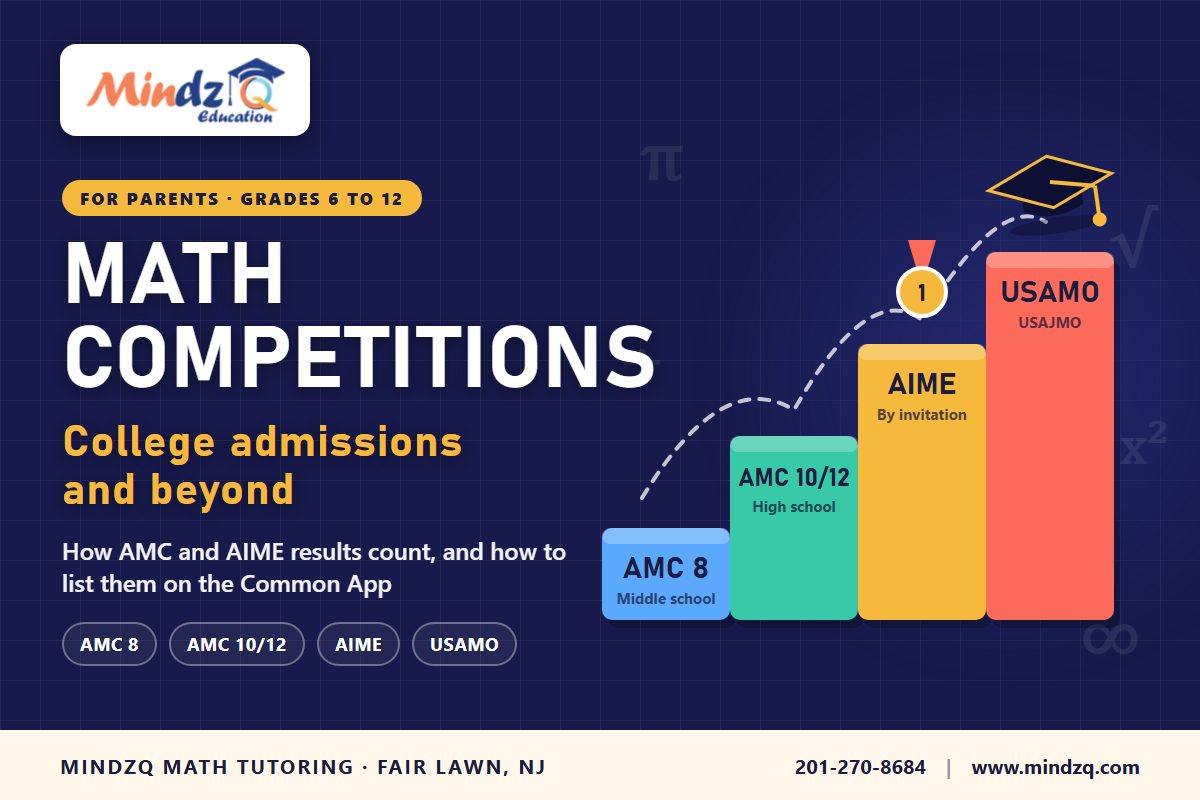
Math Competitions: College Admissions and Beyond
Math competitions offer students much more than the opportunity to earn awards and recognition. Prestigious competitions such as the AMC 8, AMC 10, and AMC 12 challenge students to think critically, solve complex problems, and demonstrate mathematical abilities beyond the traditional classroom curriculum. Strong performances, particularly qualification for advanced competitions such as the AIME, can help students stand out in competitive college admissions by showcasing their academic excellence, intellectual curiosity, and dedication to learning.
However, their value extends far beyond college applications. The analytical reasoning, creativity, and perseverance developed through these competitions are essential skills that prepare students for success in engineering, computer science, economics, business, and everyday life. Discover how the U.S. math competition pathway works, how colleges recognize these achievements, and why the benefits of competitive mathematics can last a lifetime.
- What a contest shows. How a student approaches a problem with no familiar pattern, which a transcript alone cannot show.
- The path. The AMC 8 in middle school, then the AMC 10 or 12, then the AIME for top scorers[2][3].
- Beyond admissions. Breaking a problem into steps, choosing a strategy, and checking the answer carry into engineering, computer science, economics, business, and everyday life.
- How to list it. The Common App allows ten activities and 150 characters for each description[4].
- Where to start. A free consultation and diagnostic assessment with MindzQ Education shows where a student's math stands and what to build first.
- Do math competitions help a student stand out in college admissions?
- Guide to the U.S. Math Olympiad pathway
- The value of math competitions beyond college admissions
- How do you list math competitions on the Common App?
- What is a sensible competition path from middle school?
- How do you decide whether to start?
- What mistakes weaken a competition story?
- Frequently asked questions
- Sources
Do math competitions help a student stand out in college admissions?
Yes, as evidence of how a student thinks. A transcript shows what a student has learned. A contest shows what the student does when the problem has no familiar pattern.
Exceptional mathematical achievement can help students distinguish themselves in competitive college admissions, particularly for STEM-focused programs.
MIT's admissions pages recognize the mathematical olympiad pathway as an opportunity for students to pursue their academic interests beyond school[1].
While no competition achievement guarantees college admission, strong AMC results and AIME qualification can provide meaningful evidence of academic rigor, intellectual curiosity, and exceptional mathematical reasoning.
Competitions work best alongside strong grades in a rigorous course load. MIT's page gives no rule for how a contest score is weighed[1].
Guide to the U.S. Math Olympiad pathway
The Mathematical Association of America (MAA) runs the AMC series. The details below come from its student programs page[2] and its invitational competitions page[3].
| Contest | Who can take it | Format |
|---|---|---|
| AMC 8 | Grade 8 and below, under 15.5 years old on the competition day | 25 questions, 40 minutes; held in January |
| AMC 10 | Grade 10 and below, under 17.5 | 25 multiple-choice questions, 75 minutes |
| AMC 12 | Grade 12 and below, under 19.5 | 25 multiple-choice questions, 75 minutes |
| AIME | By invitation after the AMC 10 or 12 | 15 questions, 3 hours; each answer is an integer from 0 to 999 |
| USAMO / USAJMO | By index score after the AIME | Six questions, two days, 9 hours of proof writing |
Qualification for the AIME goes to "at least the top 2.5% of all scorers" on the AMC 10 and "at least the top 5% of all scorers" on the AMC 12, and the exact cutoffs change each year[3]. The USAMO and USAJMO invitations use an index built from the AMC and AIME scores[3].

A student may not take the AMC 10 and AMC 12 on the same day[2]. Parents and students do not register directly with the MAA. Schools, colleges, math circles, or learning centers register and pay by each cycle's deadline[2]. Ask a math teacher or a local math program how they handle registration.
The MAA page lists only the 2025 to 26 dates, so confirm the 2026 to 27 dates at maa.org before you plan[2].
The value of math competitions beyond college admissions
The benefits of participating in math competitions extend far beyond strengthening college applications. Competitions such as the AMC 8, AMC 10, and AMC 12 help students develop critical thinking, analytical reasoning, and problem-solving skills that are valuable across a wide range of academic disciplines and future careers. By tackling unfamiliar problems, breaking them into manageable steps, selecting effective strategies, and evaluating their solutions, students build skills that prepare them for challenges both inside and outside the classroom.
How do these skills translate into different academic fields?
- Engineering and computer science: a competition score can signal depth beyond the course, but it does not replace the course itself.
- Business and economics: for a business-bound student, the contest shows quantitative comfort. It does not replace the activities that show leadership.
- Undecided students: contests are a low-pressure way to test whether proof-style or puzzle-style math is enjoyable. If it is not, that is useful to learn at age 13.
The benefit does not stop at admissions. Staying with a problem you cannot solve at first, trying a different approach, and checking your own answer are habits that carry into engineering projects, business decisions, and everyday life.
In our work at MindzQ Education, students who enjoy competition problems often score well on reasoning-heavy SAT Math questions but still need timing practice. The skills overlap without being identical.
Building a math plan? Start with a free consultation and diagnostic assessment. Call or text +1-201-270-8684, or book a free consultation.
How do you list math competitions on the Common App?
The Common App allows up to ten activities, and you do not need to fill all ten[4]. The description field is short. The Common App's own guidance lists these limits: 50 characters for a position or leadership description, 100 for the organization name, and 150 for the activity details, honors, and accomplishments[4].

Its advice is to keep descriptions short, abbreviate when needed, and skip hours and weeks, since those are entered in separate fields[4]. If more room is needed, the additional information question in the writing section is available[4].
Here are three sample lines for illustration. They are formats, not suggestions that any student has earned these results.
- "Qualified for AIME through AMC 10 (top 2.5% or better of scorers); founded school math circle for 12 students" (109 characters)
- "Placed in school top 3 on AMC 12; coached 6th-grade AMC 8 team weekly" (69 characters)
- "Math team captain; AMC 12 score in school top 5; led weekly problem sessions" (76 characters)
Notice that each line states a result and an action. What the student did with the skill, such as teaching or founding something, can say more than a score alone. List the contest only if the student can describe the work behind it honestly.
What is a sensible competition path from middle school?
This is our suggested path, not a requirement.
- Grades 6 to 8: try the AMC 8 in January if the school or a local center offers it[2]. Treat it as a first look.
- Grade 9: take the AMC 10 when it fits, and learn what the problems reward: patterns, estimation, and clean algebra.
- Grades 10 and 11: take the AMC 10 or 12 and aim for the AIME if the score supports it[3]. Pair this with the school's most advanced math track.
- Throughout: keep grades and course rigor first. A student with a dropping math grade should fix that before adding contest hours.
If a student's foundations are shaky, start there. Our posts on how to improve math skills before high school and whether a student is behind in math cover what to check first.
How do you decide whether to start?
Ask three questions.
- Does the student enjoy puzzle-style problems? If yes, competitions feel like play. If not, forcing it may not help.
- Is the school math sequence solid? If algebra and geometry are wobbly, fix them first.
- Is there time? Prep for the AMC rewards steady practice, not last-minute cramming.
If you answer yes to all three, a small regular practice habit is enough to start.
What mistakes weaken a competition story?
Students sometimes build the story backward from a score. A few patterns to avoid:
- Listing every contest. Ten lines of small certificates dilute one strong result. The Common App allows up to ten activities, but it does not ask you to fill them[4]. Pick the two or three that show growth or leadership.
- Quoting a score without context. "Scored 112" means nothing to a reader who has not seen the exam. State the outcome in a way that stands alone, such as qualifying for the AIME, using the rule the MAA publishes[3].
- Neglecting the school math record. The college sees grades and course levels first, and the competition sits beside them.
- Starting too late and cramming. A student who meets the contest format for the first time the week before has little chance to get comfortable with it. A handful of practice problems a week over a few months is steadier.
- Treating the result as the goal. A student who learns to stay with a problem for 20 minutes without help has gained something no score records.
Frequently asked questions
Do colleges require math competition scores?
Colleges do not require it. MIT's admissions pages say, "We don't expect or require applicants to participate in specific STEM programs at MIT or otherwise"[1]. The same page does treat competitions as a recognized path. It describes the international Olympiads, notes that "each country fields a team of its top 4-6 students in each field," and lists the US qualifying competitions, including the AMC for math[1].
Is the AMC 8 worth taking for college admissions?
It is open to students in grade 8 and below[2], so for most students its value is as a first experience and a habit.
What score counts as good on the AMC?
The MAA's invitational page gives the AIME qualification rule by percentage of scorers, and the cutoff changes each year[3]. There is no single target score.
Can a student take the AMC 10 and AMC 12 on the same day?
No[2].
Get help building a math plan
MindzQ Education offers math tutoring and enrichment, local sessions in Fair Lawn, and AP preparation for students heading to calculus. Reach out any of these ways:
- Call or text us at +1-201-270-8684
- Chat with a MindzQ Education advisor on WhatsApp
- Or book a free consultation through our website and we'll follow up within a day
Contests are one way to show how a student thinks, and they work best on top of a solid course record.